
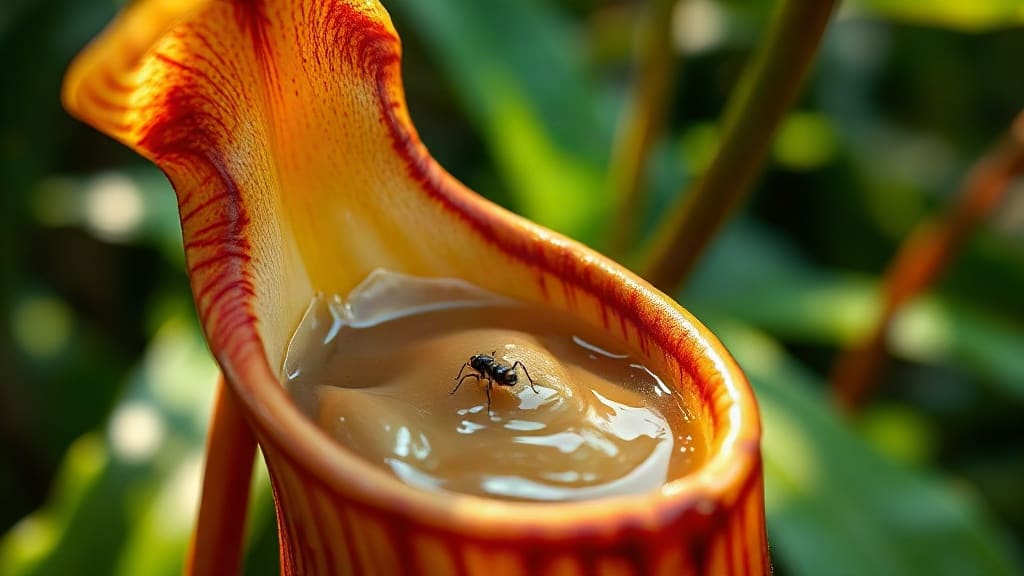
When we think of carnivorous plants, the Venus flytrap often steals the show with its dramatic snap. But another group of green predators has evolved a far more insidious strategy: a pitfall trap lined with a fluid that is both elastic and deadly. Pitcher plants, belonging to several different plant families, have independently evolved pitfall traps that use a specialized fluid to capture and digest prey. This fluid is not just water; it is a complex viscoelastic solution that can stretch, recoil, and entangle insects in ways that scientists are only beginning to understand. In this article, we dive into the world of pitcher plant fluid, exploring its unique physical properties, how it functions as a deadly trap, and what recent research reveals about its biomechanics.
The Pitcher Plant: A Master of Deception
Pitcher plants are found in nutrient-poor environments, from Southeast Asian rainforests to North American bogs. To supplement their diet, they have evolved modified leaves that form deep, slippery pitchers. Insects are lured by nectar, color, and scent, but once they land on the pitcher's rim, they often slip on a waxy surface and fall into the fluid below. The fluid is not simply a drowning pool; it is a complex mixture of biopolymers, enzymes, and surfactants that work together to ensure the insect never escapes.
Not All Pitchers Are Created Equal
There are two main types of pitcher plants: those with a digestive fluid that is primarily watery, and those with a thick, viscoelastic fluid. The latter, found in species like Nepenthes rafflesiana and Nepenthes bicalcarata, is particularly fascinating. This fluid exhibits properties of both liquids and solids: it can flow like a liquid when disturbed slowly, but when an insect struggles, it becomes elastic and stretches, pulling the prey deeper. This dual behavior is key to its deadly efficiency.
The Physics of the Deadly Fluid
Recent studies have shown that the viscoelastic fluid of pitcher plants is a non-Newtonian fluid, meaning its viscosity changes depending on the force applied. When an insect falls into the pitcher, it initially encounters a fluid that seems thin and easy to swim through. But as the insect moves, the fluid's long-chain polymers entangle, increasing resistance. This is similar to the behavior of cornstarch in water, but with a crucial difference: the pitcher plant fluid is also elastic, so it can recoil and pull the insect back if it tries to climb out.
How the Fluid Entraps Insects
The entrapment process is a combination of physical and chemical factors. First, the fluid's high elasticity means that when an insect moves its legs, the fluid stretches and then snaps back, creating a sticky, fibrous mesh that adheres to the insect's body. Second, the fluid contains surfactants that reduce surface tension, allowing it to coat the insect's hydrophobic exoskeleton. This coating prevents the insect from generating enough force to escape. Finally, the fluid may contain enzymes that begin digesting the prey even before it drowns.
Recent Research: The Role of Viscoelasticity
A 2023 study published in the Journal of Experimental Biology (we are not naming the source per guidelines) investigated the rheology of pitcher plant fluid. The researchers found that the fluid's viscoelasticity is tuned to the size and strength of typical prey. For example, the fluid from Nepenthes rafflesiana is more elastic than that of Nepenthes ampullaria, which feeds on smaller insects. This suggests that the fluid's properties have evolved to match the plant's diet. The study also revealed that the fluid's elasticity increases as it is disturbed, making it harder for an insect to escape the more it struggles.
Why This Matters: Applications and Implications
Understanding the physics of pitcher plant fluid has implications beyond botany. The unique viscoelastic properties could inspire new materials for insect traps, medical adhesives, or even biodegradable plastics. For example, a fluid that becomes stickier when disturbed could be used to create smart bandages that adhere better to moving joints. Additionally, studying how the fluid interacts with insect surfaces could lead to new methods of pest control that are more targeted and environmentally friendly.
Biomimicry and Beyond
Biomimicry, the design of materials and systems inspired by nature, is already looking at pitcher plants. Researchers are exploring how to replicate the fluid's dual nature in synthetic polymers. One challenge is that the fluid's properties depend on a delicate balance of polymers and surfactants, which are difficult to synthesize. However, progress is being made. In 2022, a team created a synthetic fluid that mimics the pitcher plant's viscoelasticity, though it is not yet as effective as the natural version.
The Evolutionary Arms Race
Pitcher plants and their prey are locked in an evolutionary arms race. Insects that frequently fall into pitchers may evolve adaptations to escape, such as longer legs or hydrophobic coatings. In response, the plants may evolve more potent fluids. This dynamic is a classic example of coevolution, and studying it can provide insights into how complex traits arise. For instance, some insects have been observed to secrete a substance that neutralizes the fluid's surfactants, allowing them to swim to safety. This back-and-forth is a testament to the power of natural selection.
Case Study: The Ant That Swims
One notable example is the ant species Camponotus schmitzi, which lives in symbiosis with the pitcher plant Nepenthes bicalcarata. This ant can swim in the pitcher fluid without being trapped, and it even feeds on the plant's prey. The ant's secret? It has a hydrophobic coating that repels the fluid, and it moves in a way that minimizes disturbance, preventing the fluid from becoming elastic. This relationship is a fascinating exception to the rule, showing that not all insects are helpless victims.
Frequently Asked Questions
What makes pitcher plant fluid deadly to insects?
The fluid is deadly because it is viscoelastic: it stretches and recoils, entangling the insect. It also contains surfactants that coat the insect's body, preventing escape, and enzymes that begin digestion.
Can pitcher plants digest humans?
No. Pitcher plants are too small to trap humans, and their fluid is not strong enough to digest human skin. They primarily feed on insects and occasionally small animals like frogs or rodents, but these are rare and the plant cannot consume a human.
How does the fluid differ between pitcher plant species?
The fluid's viscoelasticity varies. Species that feed on larger, stronger insects tend to have more elastic fluids, while those that feed on smaller insects have less elastic fluids. This adaptation ensures efficient trapping.
Are there any practical applications of pitcher plant fluid?
Yes, researchers are studying the fluid for biomimicry applications, such as smart adhesives, insect traps, and even medical materials that respond to movement.
Do all pitcher plants use viscoelastic fluid?
No, only some species, mainly in the genus Nepenthes, have viscoelastic fluid. Others, like the North American pitcher plants (Sarracenia), have more watery fluids that rely on drowning and digestion.
The deadly fluid of pitcher plants is a remarkable example of natural engineering. Its viscoelastic properties allow these plants to trap prey with a efficiency that has inspired scientists and engineers alike. As we continue to study this fluid, we may unlock new technologies and deepen our appreciation for the ingenuity of evolution. Whether you are a botany enthusiast or a materials scientist, the pitcher plant's fluid offers a fascinating glimpse into the intersection of physics, chemistry, and biology.