
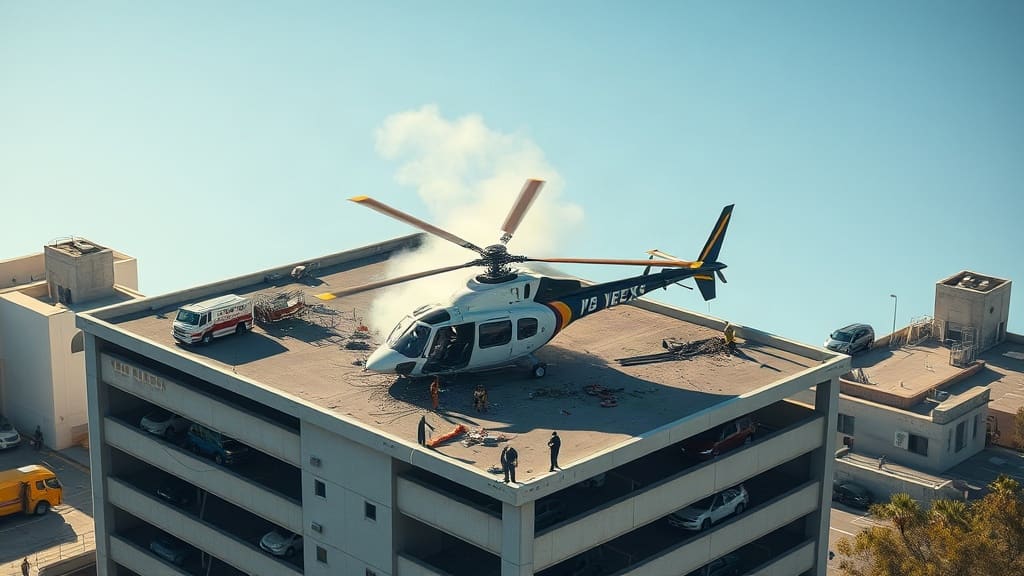
It was a routine Thursday morning for drivers pulling into the parking structure near Van Nuys Airport, but within seconds the ordinary turned catastrophic. A news helicopter, returning from covering a minor traffic incident, suddenly lost control and plummeted into the car park. The impact killed all three people aboard the aircraft and left a scene of twisted metal and smoke that first responders described as one of the worst they had encountered in years. As the Los Angeles community reels from the tragedy, investigators are now piecing together what went wrong and whether this accident could have been prevented.
What Happened in the Moments Before the Crash
According to preliminary reports from the Federal Aviation Administration and local authorities, the helicopter was a Eurocopter AS350 operated by a regional news station. It had been airborne for roughly 40 minutes, covering a car chase that had ended without serious injuries. The pilot had radioed air traffic control to request a return to the helipad at Van Nuys Airport, a common practice for news crews finishing their morning assignments. Witnesses on the ground said the aircraft appeared to be flying lower than usual as it approached the airport, but there was no immediate sign of distress. Then, without warning, the helicopter banked sharply to the right and began a rapid descent. It clipped the top edge of a five-story parking garage adjacent to a shopping center, cartwheeled across the roof, and came to rest in a fiery heap on the third level. The crash occurred at 10:47 a.m. local time, and the first 911 calls came in within seconds.
Immediate Aftermath and Emergency Response
The Los Angeles Fire Department dispatched multiple engine companies, urban search and rescue teams, and hazardous materials units to the scene. Because the car park was partially occupied at the time, there were initial fears that civilians on the ground had been injured or killed. Miraculously, no one inside the parking structure was hurt, though several vehicles were destroyed and the structural integrity of the building was compromised. Firefighters battled flames for nearly an hour before the wreckage was cool enough to approach. The three victims, later identified as the pilot, a reporter, and a photographer, were pronounced dead at the scene. Their names were withheld pending notification of next of kin, but colleagues at the news station described them as experienced professionals who had covered hundreds of stories together. A makeshift memorial of flowers and press badges appeared outside the station's headquarters by evening.
Investigation Focuses on Mechanical Failure and Weather
The National Transportation Safety Board has taken the lead in the investigation, with assistance from the FAA and the helicopter's manufacturer. Early indications suggest that a catastrophic mechanical failure may have occurred shortly before the crash. Several witnesses reported hearing a loud bang or a sudden change in engine pitch in the seconds before the helicopter veered off course. The Eurocopter AS350, also known as the AStar, is one of the most widely used helicopters in the news industry and has a generally strong safety record. However, it has been involved in several high-profile accidents in recent years, some linked to tail rotor failures or hydraulic system malfunctions. Investigators will examine maintenance logs, pilot records, and any recovered flight data to determine whether a mechanical defect, human error, or environmental factors contributed to the crash. Weather at the time was clear with light winds, making weather-related causes unlikely.
The Human Cost of Aerial Newsgathering
Beyond the mechanical questions, the crash has reignited a long-simmering debate about the risks inherent in helicopter-based news coverage. News helicopters are a staple of Los Angeles television, providing live aerial views of everything from wildfires to celebrity car chases. But that ubiquity comes at a cost. Pilots often fly at low altitudes over dense urban areas, maneuver quickly to keep a moving story in frame, and operate under tight deadlines that can encourage risky decision-making. The three journalists who died were doing a job that millions of viewers take for granted, yet their work placed them in a machine that demands constant vigilance and leaves little room for error. In the days since the crash, several news directors have quietly grounded their helicopter fleets pending the outcome of the investigation, a move that suggests the industry is taking a hard look at its own practices.
What This Means for the Future of News Helicopters
The crash comes at a time when many news organizations are already reevaluating the cost-effectiveness of helicopters. Drones have become a cheaper and often safer alternative for aerial footage, and some stations have reduced or eliminated their helicopter operations entirely. Yet helicopters still offer advantages that drones cannot match: they can fly in more weather conditions, stay airborne for hours, and carry a full crew capable of live reporting from the air. The decision to keep or ground a helicopter fleet is as much about economics as it is about safety, but accidents like this one tip the balance. If the investigation reveals a systemic flaw in the aircraft or in operating procedures, the entire industry may be forced to adopt new safety protocols or accelerate the shift to unmanned aerial vehicles. For now, the focus remains on the families of the victims and the slow, painstaking work of finding out what went wrong.
Frequently Asked Questions
What caused the news helicopter to crash in Los Angeles?
The exact cause is still under investigation by the NTSB and FAA. Early witness reports suggest a possible mechanical failure, but investigators have not yet released an official determination. They are examining maintenance records, pilot history, and any available flight data.
Who were the victims of the helicopter crash?
The three people killed were the pilot, a reporter, and a photographer working for a regional news station. Their names have been withheld until families are notified, but colleagues described them as seasoned professionals with many years of experience in aerial newsgathering.
Were there any injuries on the ground?
No. The helicopter crashed into a car park that was partially occupied, but no one on the ground was injured. Several parked vehicles were destroyed and the structure sustained damage, but all civilian injuries were avoided.
How common are news helicopter crashes?
News helicopter crashes are relatively rare but do occur. The industry has a strong overall safety record, but the nature of low-altitude urban flying and the pressure of live coverage introduce unique risks. Each accident prompts renewed scrutiny of safety procedures and equipment.
Will news stations stop using helicopters because of this crash?
It is too early to say. Some stations have temporarily grounded their helicopters pending the investigation, but a permanent shift away from helicopters would require significant operational changes. Drones are increasingly used as a supplement or alternative, but helicopters remain valuable for certain types of coverage.