
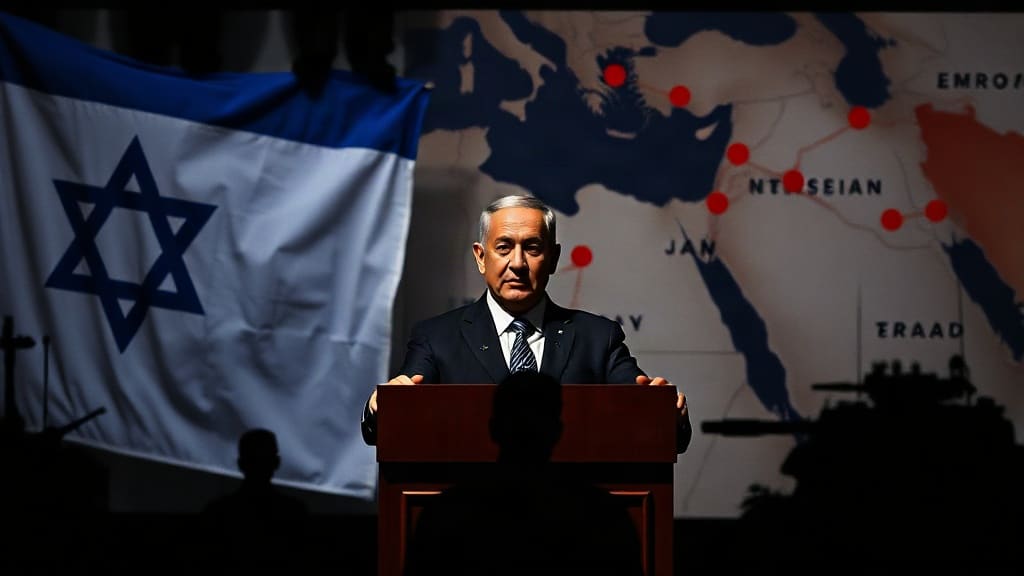
In recent weeks, Israel has found itself embroiled in a series of confrontations that seem to stretch from the West Bank to the northern border with Lebanon, and even into the shadowy realm of covert operations against Iran. On the surface, each incident has its own immediate trigger, but when viewed together, a pattern emerges: Prime Minister Benjamin Netanyahu's government appears to be actively seeking out or at least welcoming conflict on multiple frontiers. For observers both inside and outside Israel, the question is no longer whether the prime minister is pursuing a more aggressive posture, but why, and what it might cost.
The answer, according to many analysts, lies in the intersection of Netanyahu's political survival and his long-standing security doctrine. Facing a tough re-election battle, a series of corruption trials, and a deeply polarized electorate, the prime minister may see a security crisis as a way to rally voters behind him and silence his critics. In Israeli politics, nothing unites the public like an external threat, and Netanyahu has spent decades honing the image of the indispensable strongman who alone can keep the nation safe.
This strategy is not new. Throughout his career, Netanyahu has often framed his leadership as essential to Israel's security, warning of existential dangers from Iran, Palestinian militants, and hostile neighbors. But in the current climate, the stakes are higher than ever. The prime minister's legal troubles have eroded his support among centrist and left-leaning voters, while his right-wing coalition partners demand ever more forceful action against Palestinian resistance and Iranian entrenchment in Syria and Lebanon. By escalating on multiple fronts, Netanyahu may be attempting to satisfy his base, distract from his domestic woes, and position himself as the only leader capable of navigating a dangerous region.
A Multi-Front Escalation
Israel's recent military activities have been notable for their breadth. In the West Bank, the Israeli Defense Forces have conducted near-daily raids in cities like Jenin and Nablus, targeting what they describe as terrorist infrastructure. These operations have resulted in significant casualties, including civilians, and have drawn condemnation from human rights groups and the international community. The Israeli government argues that these actions are necessary to prevent attacks on Israeli citizens, but critics contend that the scale and frequency of the raids are disproportionate and driven more by political than security considerations.
Meanwhile, on the northern border, tensions with Hezbollah have simmered dangerously. Israel has conducted airstrikes in Syria targeting Iranian-linked positions and weapons convoys, and there have been exchanges of fire across the Lebanese border. While both sides have so far avoided a full-scale war, the situation remains volatile. Hezbollah's growing arsenal of precision-guided missiles and its deepening alliance with Iran pose a significant challenge to Israel's military superiority, and any miscalculation could ignite a conflict far more destructive than the 2006 war.
In the Gaza Strip, periodic rocket fire and Israeli retaliatory strikes continue, though the frequency has decreased since the last major conflict in 2021. However, the underlying issues remain unresolved, and the humanitarian situation in Gaza is dire. The Israeli blockade, now in its sixteenth year, has crippled the economy and left the population heavily dependent on international aid. Hamas, the de facto authority in Gaza, has largely maintained a ceasefire, but sporadic violence persists, and the risk of another escalation is ever-present.
The Iran Shadow War
Perhaps the most concerning front is the ongoing shadow war with Iran. Israel has reportedly carried out numerous covert operations inside Iran, targeting nuclear scientists, military facilities, and cyber infrastructure. These operations, which Israel rarely acknowledges, are part of a broader campaign to prevent Iran from acquiring nuclear weapons and to roll back its regional influence. The most recent escalation has involved attacks on Iranian shipping and drone strikes on military sites, raising fears of a direct confrontation between the two countries.
Iran, for its part, has accelerated its nuclear program, enriching uranium to levels that alarm Western intelligence agencies. The collapse of the 2015 nuclear deal, which Netanyahu fiercely opposed, has left the international community with few diplomatic tools to constrain Iran's ambitions. Israel has made clear that it will not allow Iran to become a nuclear-armed state, and the current Israeli government has hinted that military action could be on the table if diplomacy fails. This has created a tense standoff in which both sides are testing each other's red lines.
Domestic Politics and the Security Card
At the heart of this aggressive posture is Netanyahu's political predicament. The prime minister is facing an ongoing trial on corruption charges, and his coalition government, which includes far-right and ultra-Orthodox parties, is one of the most hawkish in Israel's history. To maintain his grip on power, Netanyahu must keep his coalition partners satisfied, and many of them are pushing for a more confrontational approach toward the Palestinians and Iran. By adopting a hardline stance, Netanyahu can also appeal to his core supporters, who view any concession or restraint as weakness.
Moreover, security crises have historically benefited Netanyahu at the ballot box. In 1996, he won a surprise victory after a wave of Palestinian suicide bombings. In 2001, he was elected prime minister following the outbreak of the Second Intifada. More recently, military operations in Gaza have boosted his approval ratings, at least temporarily. With elections possibly looming, Netanyahu may be calculating that a controlled escalation that demonstrates strength without triggering a full-blown war could shore up his support and distract from his legal troubles.
However, this strategy carries significant risks. A prolonged conflict or a high-casualty operation could backfire, generating international condemnation and domestic backlash. The Israeli public, while generally supportive of strong security measures, is also weary of endless conflict. Many Israelis remember the heavy toll of past wars and are wary of being drawn into a quagmire. If Netanyahu is seen as recklessly endangering the country for personal political gain, it could alienate moderate voters and even some within his own coalition.
The Regional and International Dimension
Israel's aggressive posture also has implications for the broader Middle East. The normalization agreements with several Arab states, known as the Abraham Accords, were premised on the idea that Israel could build partnerships without resolving the Palestinian issue. But as violence in the West Bank intensifies and settlement expansion continues, these agreements are coming under strain. Arab governments that have recognized Israel face pressure from their own populations and from the broader Arab and Muslim world to respond to Israeli actions. A major escalation could jeopardize these nascent relationships and derail further normalization efforts.
At the international level, Israel's actions have drawn criticism from the United Nations, the European Union, and various human rights organizations. The Biden administration, while maintaining its support for Israel's security, has expressed concern about settlement expansion, the high number of Palestinian casualties, and the lack of a political horizon. The U.S. has also urged restraint on both sides, but its leverage appears limited. Netanyahu's relationship with the Biden administration has been strained, and the prime minister has shown little willingness to heed Washington's advice.
This diplomatic isolation is a double-edged sword. On one hand, it reinforces the narrative that Israel stands alone against a hostile world, which plays well with Netanyahu's base. On the other hand, it limits Israel's ability to coordinate with allies and could leave it more vulnerable in the event of a major crisis. The lack of a credible peace process also undermines Israel's long-term security, as it perpetuates the conditions that fuel extremism and resistance.
The Cost of Perpetual Conflict
Beyond the immediate political calculus, there is a deeper question about the sustainability of Israel's current approach. The country has been in a state of near-constant conflict since its founding, and each generation has known war. The human, economic, and psychological toll is immense. Military service is mandatory for most citizens, and the threat of rocket attacks and terrorism is a daily reality in many parts of the country. The occupation of the West Bank, now in its sixth decade, has created a system of control that many Israelis themselves find troubling, and it has eroded Israel's international standing.
Some Israeli security experts argue that the current strategy is not only unsustainable but also counterproductive. They point out that military operations may provide short-term deterrence but do not address the underlying political and social drivers of the conflict. Without a serious effort to reach a political settlement with the Palestinians, they warn, Israel will continue to face cycles of violence, and its democratic character will be further eroded. These voices, however, are increasingly marginalized in a political climate that rewards toughness and punishes compromise.
For Netanyahu, the choice to escalate may be rational in the short term, but it carries enormous risks. A miscalculation on any front could lead to a war that Israel may not be able to win decisively, and the political fallout could be severe. The prime minister has built his career on the promise of security, but if his aggressive policies lead to greater insecurity, that promise will ring hollow.
What Comes Next?
The coming weeks and months will be critical. The situation in the West Bank remains volatile, with no end in sight to the Israeli raids and Palestinian attacks. The northern border is tense, and any incident could spark a wider confrontation. The shadow war with Iran continues unabated, with both sides pushing the limits of plausible deniability. And domestically, Netanyahu continues to face legal and political challenges that could force early elections or even bring down his government.
In this environment, the risk of a major conflict is higher than it has been in years. Whether Netanyahu is deliberately seeking such a conflict or simply willing to accept it as a byproduct of his political strategy, the outcome could be devastating for Israelis and Palestinians alike. The international community, for its part, seems unable or unwilling to intervene effectively, leaving the region to drift toward another round of bloodshed.
Ultimately, the question is not just about Netanyahu's intentions, but about the future of Israel itself. A nation that is constantly looking for a fight may find that it cannot escape one, and the price of that fight may be far greater than any political gain. As the prime minister weighs his options, the people of Israel and the wider region hold their breath, hoping that cooler heads will prevail.
Frequently Asked Questions
Why is Netanyahu escalating conflicts on multiple fronts?
Netanyahu's escalation is widely seen as a strategy to rally domestic support amid legal troubles and political instability. By focusing on security threats, he aims to unite voters behind his leadership and satisfy his hawkish coalition partners.
What are the main fronts of Israel's current military engagements?
Israel is active in the West Bank with near-daily raids, on the northern border with airstrikes in Syria and tensions with Hezbollah, in Gaza with periodic exchanges of fire, and in a covert shadow war with Iran involving cyberattacks and targeted operations.
How does the Iranian threat influence Israeli policy?
Iran's advancing nuclear program and its support for militant groups like Hezbollah are seen by Israel as existential threats. The Israeli government has signaled that it may take military action to prevent Iran from acquiring nuclear weapons, raising the stakes for a wider conflict.
What are the risks of Netanyahu's aggressive approach?
The risks include a full-scale war with Hezbollah or Iran, international isolation, damage to the Abraham Accords, and domestic backlash if the public perceives the escalation as politically motivated and dangerous. A miscalculation could lead to heavy casualties and long-term instability.
Could this strategy backfire on Netanyahu politically?
Yes. While security crises often boost a leader's popularity in the short term, a prolonged or costly conflict could erode public support. Many Israelis are weary of endless war, and if Netanyahu is seen as endangering the country for personal gain, it could lead to his political downfall.