
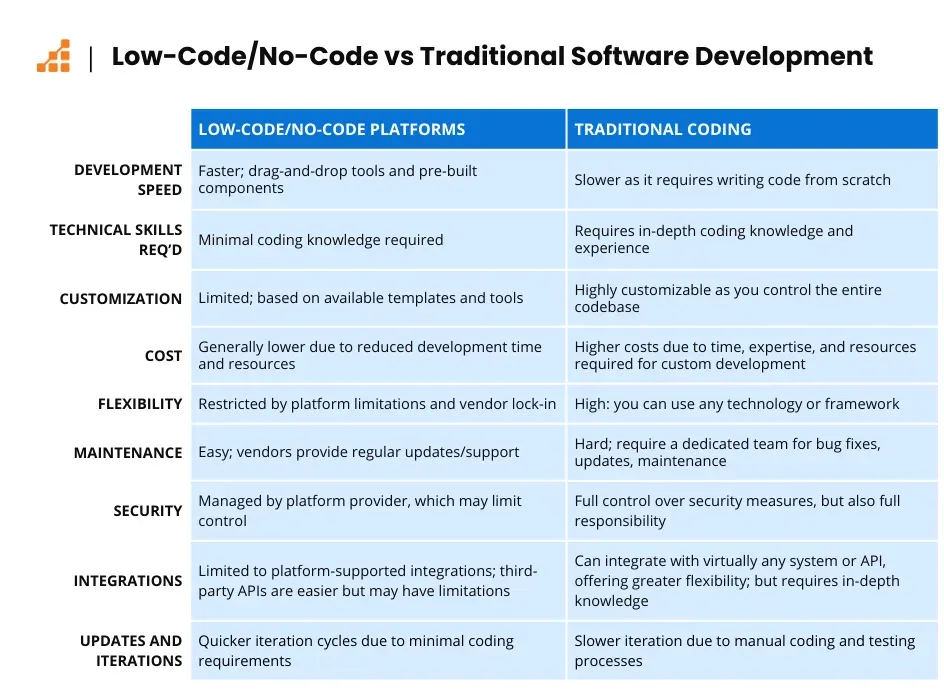
Low-Code vs No-Code vs Traditional Software Development presents a spectrum of approaches shaping how teams build software today. From rapid visual assembly to full-blown custom code, each path offers different trade-offs between speed, control, and governance. We’ll explore low-code development advantages, no-code platform differences, and traditional software development vs low-code to reveal where each excels and where trade-offs emerge. Consider when to choose no-code as a starting point for rapid validation, alongside the pros and cons of no-code and low-code for governance, security, and long-term maintainability. This practical framework helps you decide whether a quick MVP, broader automation, or a custom, scalable solution is the right path for your project, budget, and risk tolerance.
Beyond the naming, the topic is evolving toward flexible, visual tooling that speeds delivery without sacrificing governance. In LSI terms, this means talking about drag-and-drop builders, model-driven development, and code-free platforms alongside traditional software engineering. You’ll see terms like rapid application development, citizen developers, and scalable cloud architectures used to describe different flavors of the same goal. The key is choosing the toolset that aligns with your team’s skills, risk profile, and long-term maintenance plan.
Low-Code vs No-Code vs Traditional Software Development: Choosing the Right Path for Speed, Control, and Governance
In evaluating Low-Code vs No-Code vs Traditional Software Development, organizations weigh speed, flexibility, and control. The low-code development advantages include faster prototyping, easier maintenance, and the ability to empower citizen developers under supervision. At the same time, this middle-ground approach must address vendor lock-in, performance considerations, and constraints around unique integrations when compared to traditional software development.
As teams compare no-code platform differences with more traditional approaches, they should consider governance, scalability, and security alongside time-to-value. The discussion of the traditional software development vs low-code path often centers on the balance between customization and governance. And when weighing the pros and cons of no-code and low-code, organizations assess speed and accessibility against extensibility, control, and long-term maintenance.
When to Choose No-Code: Fast Delivery, Guardrails, and Governance
Determining when to choose no-code hinges on process simplicity, repeatability, and the need for rapid value. For straightforward forms, approvals, data collection, and lightweight customer-facing apps, no-code can deliver quickly with strong business user involvement. This makes the case for no-code in scenarios where stakeholders want to test ideas rapidly and iterate with minimal IT burden, aligning with the concept of when to choose no-code.
However, no-code also comes with platform differences in customization, security controls, and scalability. Evaluating the pros and cons of no-code and low-code helps governance teams plan for risk, data governance, and future migration if needs outgrow the platform. By acknowledging no-code platform differences and potential limits, organizations can maintain security, compliance, and portability while harnessing rapid delivery.
Frequently Asked Questions
Low-Code vs No-Code vs Traditional Software Development: What are the key factors to consider, and what are the low-code development advantages and the pros and cons of no-code and low-code?
Low-Code vs No-Code vs Traditional Software Development: The right choice depends on speed, governance, and required customization. Low-code development advantages include faster prototyping and enabling citizen developers while maintaining some code access, but beware of vendor lock-in and integration constraints. The pros and cons of no-code and low-code should be weighed: no-code offers speed and simplicity but limits customization and scalability, while low-code offers more flexibility yet still imposes platform boundaries. Traditional software development provides maximum control, security, and performance for complex or regulated systems, but requires longer timelines and larger teams. Use this framework to balance these trade-offs and plan for evolution if your needs outgrow the platform.
How should an organization decide when to choose no-code vs low-code vs traditional software development, considering no-code platform differences and traditional software development vs low-code trade-offs?
To decide when to choose no-code vs low-code vs traditional software development, start with the business problem and data requirements. Then evaluate complexity and governance: simple workflows favor no-code, while more complex automation aligns with low-code; for mission-critical systems, consider the traditional software development vs low-code trade-offs. Consider no-code platform differences—differences in customization, security, and portability—that can affect future needs and migration. Run a small pilot to compare time-to-value and maintainability, and plan an evolution path if you anticipate migrating to traditional development later.
| Section | Key Points | Notes/Examples |
|---|---|---|
| Understanding the three approaches |
|
|
| When to choose Low-Code |
|
Low-code serves as a balance between speed and control, enabling quicker iteration while allowing essential customization. |
| When to choose No-Code |
|
No-code is ideal for rapid digitization of simple processes, with eventual upgrade paths if complexity grows. |
| When to choose Traditional Software Development |
|
Traditional development remains best for core systems where governance, security, and bespoke features matter most. |
| Evaluating trade-offs |
|
Weigh both immediate delivery needs and long-term maintainability and risk, regardless of path. |
| A practical decision framework |
|
A structured approach helps choose the right path and plan future migrations if needed. |
| Practical considerations and best practices |
|
Quality and security should be built in from the start, regardless of the development path. |
| Real-world scenarios and case studies |
|
Examples illustrate staged transitions and governance considerations. |
| Measuring success and continuing improvement |
|
Continuous improvement depends on feedback loops and evolution of platform capabilities. |