
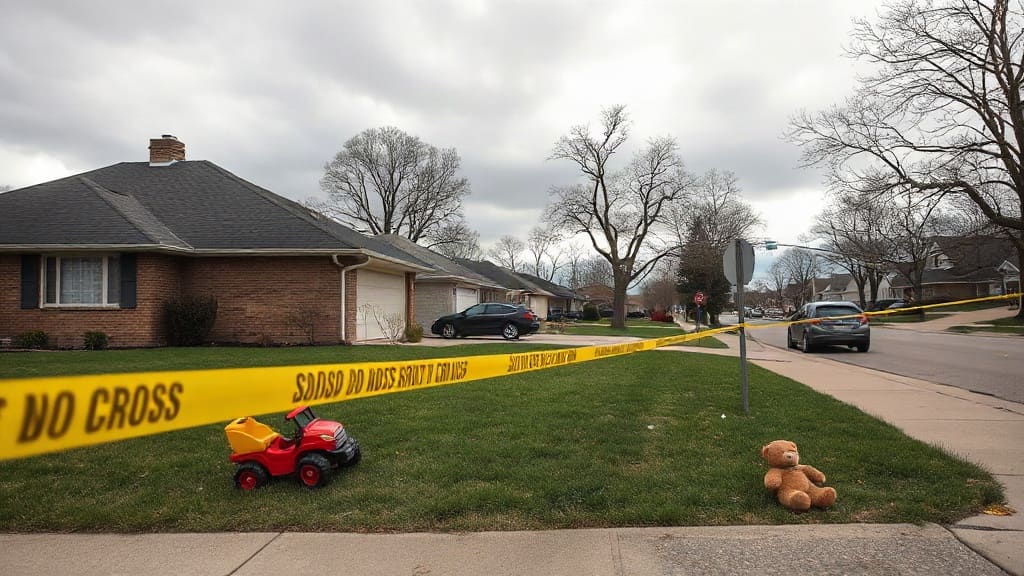
The quiet suburb of Western Springs, Illinois, was shattered last week when two-year-old Barrett Walsh was found dead in the basement of his family home. His mother, 40-year-old Corie Walsh, now faces three counts of first-degree murder. As investigators piece together the events leading to the tragedy, a disturbing detail has emerged: prosecutors say Walsh was deeply engrossed in the high-profile trial of Lindsay Clancy, the Massachusetts mother accused of killing her three children, and was texting friends about the case just hours before her own son's death.
The revelation adds a haunting layer to an already heartbreaking case, raising questions about the influence of true crime media on vulnerable individuals and the complex intersection of mental health and criminal responsibility in maternal filicide cases.
The Timeline of a Tragedy
According to court records obtained by NBC Chicago, police were called to the Walsh family home on Tuesday, September 1, 2026, after Barrett was reported missing. Officers arrived to find the toddler unresponsive in the basement. Despite efforts to revive him, Barrett was pronounced dead at the scene. Corie Walsh was taken into custody later that day and has been held without bond since her initial court appearance.
The Cook County State's Attorney's Office has not released a detailed narrative of what they believe happened inside the home. However, prosecutors have stated that Walsh's actions were deliberate and premeditated. The three counts of first-degree murder suggest that authorities believe there were multiple aggravating factors, though the exact nature of those factors remains under seal.
A Disturbing Obsession with the Clancy Case
At the heart of the prosecution's case is Walsh's alleged fixation on the trial of Lindsay Clancy, a Duxbury, Massachusetts, mother charged with strangling her three children in January 2023 before attempting suicide. Clancy's trial began in August 2026 and has drawn national attention due to her defense's argument that she was suffering from severe postpartum psychosis and was overmedicated at the time of the killings.
Prosecutors claim that Walsh had been following the Clancy trial closely, watching live streams, reading articles, and discussing the case with friends via text message. In one text exchange, allegedly sent just hours before Barrett's death, Walsh reportedly expressed intense interest in Clancy's mental state and the legal strategies being used. Authorities have not released the full contents of the messages, but they characterize Walsh as being "very invested" in the outcome of the trial.
This detail has sent shockwaves through both communities, as it suggests a possible imitation or inspiration factor. Legal experts caution, however, that a direct causal link is far from established. "People follow true crime for many reasons, and the vast majority never commit violence," said Dr. Karen Franklin, a forensic psychologist who has studied copycat crimes. "But when you have an individual already struggling with severe mental health issues or contemplating harm, exposure to detailed accounts of similar acts can sometimes lower the threshold for action."
The Lindsay Clancy Case: A National Obsession
To understand the potential influence, one must first understand the Clancy case. Lindsay Clancy, a 32-year-old labor and delivery nurse, allegedly killed her children Cora (5), Dawson (3), and Callan (8 months) on January 24, 2023, before jumping from a second-story window in a suicide attempt. She survived but was left paralyzed from the waist down. Her trial, which began in August 2026, has been marked by emotional testimony and competing expert opinions on her mental state at the time of the killings.
Clancy's defense argues that she was suffering from postpartum psychosis, a rare but severe mental illness that can cause delusions, hallucinations, and a break from reality. Her attorneys contend that a combination of prescribed medications, including benzodiazepines and SSRIs, contributed to a psychotic state that left her unable to understand the nature of her actions. The prosecution, however, maintains that Clancy was aware of what she was doing and that her actions were driven by anger and exhaustion, not psychosis.
The case has become a flashpoint in the national conversation about postpartum mental health, the criminal justice system's treatment of mentally ill defendants, and the role of medication in violent behavior. It has also been heavily covered by true crime podcasts, YouTube channels, and social media, making it one of the most discussed criminal trials of the year.
What We Know About Corie Walsh
Corie Walsh, a 40-year-old mother, lived with her husband and son in Western Springs, a village about 15 miles west of Chicago. Neighbors describe the family as quiet and unassuming. Barrett was the couple's only child. Walsh's husband has not been charged and is cooperating with investigators, according to police. He was reportedly at work when the incident occurred.
Walsh's own mental health history is not yet public, though it will likely become a central issue in her defense. Her attorneys have not yet commented on the case, and no plea has been entered. However, the prosecution's emphasis on her interest in the Clancy trial suggests they may be building a narrative of premeditation, arguing that Walsh studied a similar case before acting.
"The prosecution will likely use her texts and search history to show that she was not in a psychotic state, but rather was rationally planning," said former prosecutor and legal analyst Jennifer Coates. "If they can demonstrate that she was consuming media about Clancy and discussing it with others in a coherent way, it undermines any argument that she was detached from reality."
But defense attorneys may counter that a person in the throes of a psychotic episode can still appear functional in some areas, especially when communicating via text. The human mind is complex, and the line between obsession and delusion is not always clear.
The Dark Side of True Crime Consumption
The Walsh case has reignited a long-simmering debate about the ethics and potential dangers of true crime media. While millions of people consume true crime content daily without issue, critics argue that the genre often sensationalizes violence and can inadvertently provide a blueprint for those who are vulnerable. The Clancy trial, with its dramatic details and intense media coverage, may have been particularly compelling for someone already struggling with maternal rage or suicidal ideation.
"We have to be careful not to overstate the causal link," said Dr. Franklin. "But we also can't ignore that in rare cases, individuals do model their crimes on high-profile cases. It's a phenomenon known as copycat crime, and it's been documented since the days of Jack the Ripper."
For families in Western Springs and beyond, the case is a stark reminder that evil or illness can hide behind the most ordinary facades. The community has rallied around Barrett's father, organizing vigils and fundraisers. A GoFundMe page set up for the family has raised over $50,000.
Legal Implications and What Comes Next
Corie Walsh's next court date is scheduled for later this month, where she is expected to enter a plea. If convicted of first-degree murder, she faces a mandatory sentence of 20 to 60 years in prison, and possibly life without parole if aggravating factors are proven. The Illinois statute does not have a separate charge for filicide, so the case will be tried under general murder laws.
Legal experts predict that Walsh's defense team will likely pursue an insanity defense or a claim of diminished capacity, similar to the strategy employed by Lindsay Clancy's attorneys. However, the success of such a defense in Illinois is uncertain. The state uses a modified version of the M'Naghten rule for insanity, which requires the defendant to prove that due to a mental disease or defect, they lacked substantial capacity to appreciate the criminality of their conduct or to conform their conduct to the requirements of the law.
"The bar for an insanity defense is high," said Coates. "Even in cases with clear evidence of mental illness, juries are often reluctant to find a defendant not guilty by reason of insanity, especially in cases involving children."
The prosecution, meanwhile, will likely focus on the premeditation angle, using Walsh's alleged obsession with the Clancy trial to paint a picture of a woman who planned her son's death with chilling deliberation. The text messages, if admitted into evidence, could be devastating.
A Community in Mourning
As the legal process unfolds, the people of Western Springs are left to grapple with an unthinkable loss. Barrett Walsh was described by neighbors as a happy, energetic toddler who loved trucks and playing in the yard. His death has left a hole in the community that will never be filled.
"You never think something like this will happen here," said one neighbor, who asked not to be named. "It's the kind of thing you see on the news and think, 'That's so sad, but it's not us.' And then it is us."
The case also serves as a sobering reminder of the importance of mental health support for parents. Postpartum depression and psychosis are real, treatable conditions, but they often go undiagnosed due to stigma and lack of access to care. If anything positive can come from this tragedy, it may be a renewed focus on maternal mental health and the resources available to struggling parents.
The Road Ahead
The trials of both Lindsay Clancy and Corie Walsh will continue to unfold over the coming months, each shedding light on the darkest corners of the human mind. While the legal outcomes remain uncertain, one thing is clear: the conversation about maternal filicide, mental health, and media influence is far from over. As these cases proceed, they will force us to confront uncomfortable questions about responsibility, compassion, and the nature of evil.
For now, the focus remains on Barrett, a little boy whose life was cut tragically short, and on the family and community left to pick up the pieces. The echoes of his story, and the disturbing parallels to another mother's alleged crimes, will linger long after the verdicts are read.
Frequently Asked Questions
Who is Corie Walsh and what is she charged with?
Corie Walsh is a 40-year-old mother from Western Springs, Illinois, charged with three counts of first-degree murder in the death of her two-year-old son, Barrett. She was arrested after the child was found dead in the basement of the family home on September 1, 2026.
What is the connection between Corie Walsh and the Lindsay Clancy trial?
Prosecutors allege that Walsh was closely following the trial of Lindsay Clancy, a Massachusetts mother accused of killing her three children. Walsh reportedly texted friends about the case hours before her son's death and was described as "very invested" in the trial's outcome.
Could the Lindsay Clancy case have influenced Corie Walsh's alleged actions?
While it is too early to establish a direct causal link, legal and psychological experts note that in rare cases, individuals may model their crimes on high-profile cases. The prosecution may use Walsh's alleged interest in the Clancy trial to argue premeditation, while the defense could argue it was a symptom of mental illness.
What is postpartum psychosis and how does it relate to these cases?
Postpartum psychosis is a rare but severe mental illness that can occur after childbirth, causing delusions, hallucinations, and a break from reality. Lindsay Clancy's defense has argued she suffered from this condition. Whether Corie Walsh had a similar diagnosis is not yet known, but it may become a factor in her case.
What penalties could Corie Walsh face if convicted?
If convicted of first-degree murder in Illinois, Walsh faces a sentence of 20 to 60 years in prison, and potentially life without parole if aggravating factors are proven. The case is still in its early stages, and no plea has been entered.