
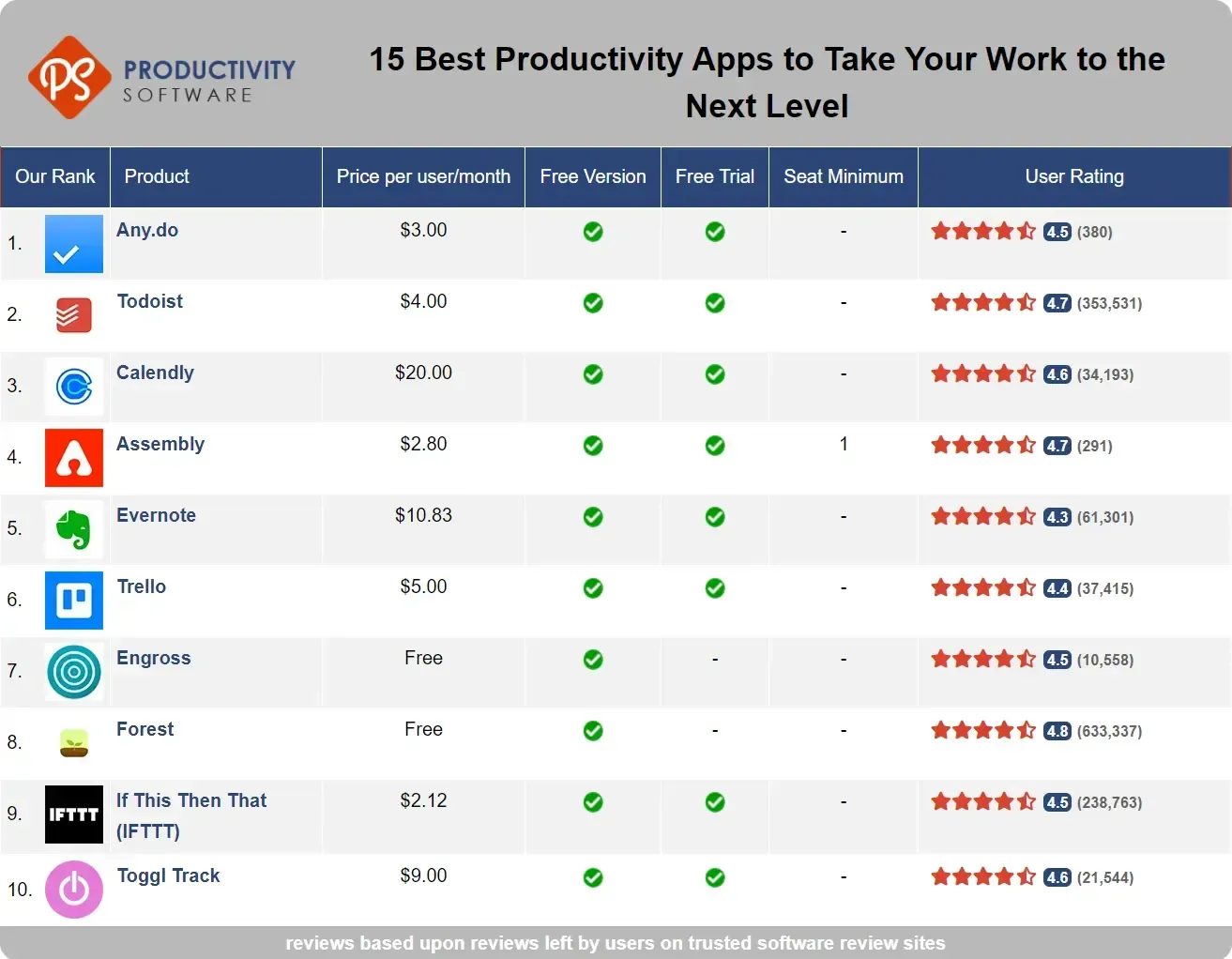
Best Apps for Productivity provide a curated toolkit that helps you turn scattered tasks into a clear, focused plan and set up a daily rhythm that aligns with your priorities, energy patterns, and deadlines, while also supporting a flexible system you can audit weekly. When you select tools that complement your workflow, you gain access to top productivity tools and powerful productivity apps designed to reduce overhead, automate routine steps, and keep priorities visible across devices, teams, and projects, while also scaling seamlessly across mobile and desktop, ensuring your team stays aligned even when people work remotely, and giving you auditable traces of decisions. A smart stack blends time management apps with workflow automation apps to minimize context switching and speed up routine work, while also offering insight into where time leaks occur through dashboards and reports. Beyond tools, the real value comes from choosing a lean set of task management apps, note systems, and calendar aids that fit how you work, helping you maintain momentum even on busy days and preventing notification fatigue. In this article, you’ll learn how to assemble a cohesive kit that scales with your goals, includes guardrails for consistent behavior, and adapts as your role, projects, and priorities evolve—so you can focus on outcomes, not options.
From a semantic perspective, the ecosystem of efficiency software you choose should support clarity, consistency, and momentum across daily routines. Think of this as a productivity suite that blends task tracking, calendar coordination, and automated sequences to reduce manual handoffs. By approaching software as an interconnected system rather than a collection of standalone tools, you leverage related terms like project management apps, note-taking platforms, and collaboration hubs to reinforce a coherent workflow. The emphasis shifts from chasing features to solving real friction points—email overload, constant interruptions, and slow feedback loops—using optimization-focused apps and automation workflows. In the following sections, you’ll see practical criteria for evaluating options and steps to tailor a stack that supports your goals while remaining easy to maintain.
Best Apps for Productivity: Crafting a Lean, High-Impact Toolkit
Choosing the Best Apps for Productivity means building a lean, integrated stack that covers task management, note-taking, scheduling, and focus. By selecting a core set of tools, you create a predictable workflow that minimizes context switching and decision fatigue. This approach prioritizes quality over quantity, ensuring each app serves a concrete purpose within your daily routine.
In this framework, look for productivity apps that collaborate well with your existing systems and data. Favor task management apps that offer clear prioritization and progress visibility, plus workflow automation apps that reduce repetitive steps. The goal is a cohesive toolkit—one that amplifies your efficiency without becoming a distraction in itself.
Time-Smart Productivity: Master Time Management Apps, Scheduling, and Workflow Automation
A robust time management strategy centers on calendar-first planning, deliberate time blocking, and dedicated focus periods. Time management apps help you understand where your minutes actually go, enabling smarter decisions about what to protect and what to delegate. When paired with scheduling tools, you can synchronize commitments across personal and team calendars to prevent overload.
Automation plays a crucial role in extending your productive hours. Workflow automation apps connect your favorite productivity tools, turning repetitive steps into seamless, background processes. By measuring impact through simple metrics like time saved, tasks completed vs. planned, and focus time achieved, you can continuously refine your stack and avoid the common pitfall of tool overload while maintaining maximum efficiency.
Frequently Asked Questions
What are the Best Apps for Productivity to streamline my workday?
Best Apps for Productivity refers to a cohesive stack of tools that help you capture, organize, schedule, focus, and automate. A practical starter stack includes task management apps (Todoist or Asana), notes and documents (Notion), a calendar (Google Calendar or Outlook), time management apps and focus tools (RescueTime and Pomodoro timers), and workflow automation apps (Zapier). The goal is interoperability and minimal friction—choose apps that fit your workflow and sync across devices. Use this stack to reduce context switching, protect deep work blocks, and automate repetitive steps, then review and refine over time.
How can I choose top productivity tools for time management and task management within the Best Apps for Productivity framework?
To build an effective productivity stack and apply the Best Apps for Productivity framework, start by identifying your bottlenecks (email overload, scattered tasks, or calendar chaos). Choose a primary task management app (Todoist or Asana) to capture and prioritize work, then add time management apps for focus (RescueTime, focus timers) and a notes app (Notion) for context. Integrate calendar and scheduling apps (Google Calendar) to block time, and introduce workflow automation apps (Zapier) to connect actions. This approach yields a set of top productivity tools that supports not only task management and time management but also cross-app workflows, reducing manual effort and keeping you aligned with your goals.
| Topic | Key Points | Examples / Tools |
|---|---|---|
| Introduction | Right apps reduce friction, automate repetitive steps, and keep work aligned with goals. | Best Apps for Productivity (overall goal) |
| Why Tools Matter |
|
|
| Task Management Apps |
|
Todoist, Notion (task databases), Asana |
| Note-Taking Apps |
|
Notion, Evernote, Google Keep |
| Calendar & Scheduling Apps |
|
Google Calendar, Outlook, Fantastical |
| Time Management Apps |
|
RescueTime, Focus@Will, Pomodoro timers |
| Workflow Automation Apps |
|
Zapier, IFTTT |
| Focus & Distraction-Blocking Tools |
|
Website blockers, focus timers |
| Top Starter Stack |
|
Task: Todoist/Asana; Notes: Notion; Calendar: Google Calendar/Outlook; Focus/Time: RescueTime + TomatoTimer; Automation: Zapier |
| Building & Tailoring Stack |
|
— |
| Real-World Workflow |
|
— |
| Measuring Impact |
|
— |
| Common Pitfalls |
|
— |
| Conclusion |
|
— |
Summary
Best Apps for Productivity is not about chasing the flashiest tools but about building a cohesive workflow that fits your life. A thoughtful stack—covering task management, notes, calendar, time management, automation, and focus—lets you capture ideas, prioritize actions, allocate time, minimize distractions, and automate repetitive steps. Start with a lean core, then tailor your tools to your routine through incremental adoption, weekly reviews, and measurement of impact. This descriptive journey emphasizes clarity, integration, privacy considerations, and ongoing refinement, so your daily workflow becomes predictable, efficient, and less stressful. By embracing the Best Apps for Productivity mindset, you can reclaim time for meaningful work and personal well-being, turning chaotic days into steady progress and sustainable productivity.