
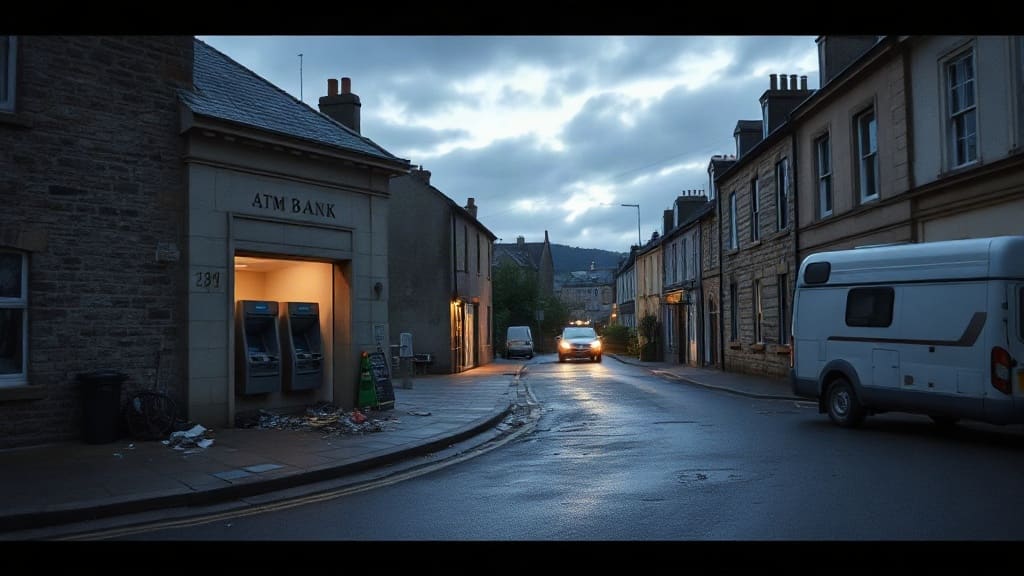
The quiet Scottish Borders town of Peebles woke to unsettling news: two cash machines had been ripped from the wall of a Royal Bank of Scotland branch and carted off in a horsebox. The audacious theft, which occurred overnight, has left locals stunned and police scrambling for leads. While the exact timing and method remain under investigation, the incident raises urgent questions about the security of cash infrastructure in rural communities.
According to initial reports, the ATMs were forcibly removed from the branch on the town's high street. The use of a horsebox as a getaway vehicle is particularly unusual, suggesting a degree of premeditation. Authorities have not yet released details about the suspects or the amount of money stolen, but the brazen nature of the crime has sparked widespread concern.
What Happened in Peebles?
The theft took place in the early hours of the morning, when the town was largely deserted. Witnesses describe hearing loud noises, but few realized what was happening until daylight revealed the damage. The Royal Bank of Scotland branch, a familiar landmark in Peebles, now bears the scars of the attack: broken masonry, exposed wiring, and empty spaces where the ATMs once stood.
Police Scotland has launched an investigation and is appealing for information. Detective Inspector Laura Miller said: "This was a brazen attack that has caused significant damage to the bank and disrupted cash access for the local community. We are pursuing various lines of inquiry and would urge anyone with information to come forward."
The use of a horsebox to transport the stolen machines is a detail that has puzzled many. Horseboxes are common in rural areas, and their presence might not arouse suspicion. However, they are not typically associated with heavy machinery theft. It is possible that the perpetrators chose this vehicle for its capacity and relative anonymity.
Why Target ATMs in Rural Towns?
ATM thefts are not new, but they have evolved over the years. In rural areas, cash machines are often the only convenient source of cash, especially as bank branches close. This makes them attractive targets for organized crime groups. The machines themselves contain significant amounts of cash, and the remote locations can mean longer police response times.
Moreover, the methods used by thieves have become more sophisticated. In some cases, they use heavy machinery like diggers to rip ATMs from walls; in others, they use explosives or cutting tools. The Peebles incident, with a horsebox as the getaway vehicle, suggests a different approach, perhaps leveraging local knowledge and available resources.
The impact on the community is immediate: residents now face limited access to cash, and the bank branch may remain closed for repairs. For small businesses that rely on cash transactions, this disruption can be particularly challenging.
The Broader Context of Cash Machine Security
Cash machines are a critical part of the financial infrastructure, but their security is a constant challenge. Banks invest heavily in protective measures such as reinforced walls, alarm systems, and GPS trackers. However, determined criminals often find ways to circumvent these defenses.In recent years, there has been a rise in ATM attacks across the UK. According to industry data, incidents involving physical attacks on ATMs have increased, with criminals using increasingly violent methods. This has prompted calls for better security and perhaps a reevaluation of how cash is distributed and protected.
For rural communities, the loss of an ATM can be more than an inconvenience. It can mean traveling long distances to access cash, which is especially problematic for the elderly or those without transportation. It also raises concerns about the viability of local businesses that depend on cash.
What Can Be Done to Prevent Future Thefts?
Preventing ATM theft requires a multi-faceted approach. Banks can enhance physical security by installing bollards, using stronger materials, and improving surveillance. They can also employ technology such as ink staining or GPS tracking to deter thieves and aid recovery.
Community awareness is also key. Residents should report suspicious activity, especially at night. Local authorities can work with banks to ensure that ATMs are located in well-lit, visible areas. In some cases, moving ATMs inside buildings or into secure vestibules can reduce risk.
Finally, there is a need for greater collaboration between law enforcement and financial institutions. Sharing intelligence and best practices can help stay one step ahead of criminals.
FAQ
What exactly happened at the Royal Bank of Scotland in Peebles?
Two cash machines were forcibly removed from the branch and taken away using a horsebox. The theft occurred overnight, and police are investigating.
Were any arrests made in connection with the ATM theft?
As of now, no arrests have been reported. Police Scotland is appealing for information and pursuing leads.
How does this affect local residents and businesses?
The theft has left the community without easy access to cash, causing inconvenience and potential hardship for those who rely on cash transactions.
What security measures do banks use to protect ATMs?
Banks employ various measures including reinforced installations, alarms, surveillance cameras, and sometimes GPS trackers or ink staining technology.
Is ATM theft a growing problem in the UK?
Yes, there has been an increase in physical attacks on ATMs in recent years, particularly in rural areas where response times may be longer.