
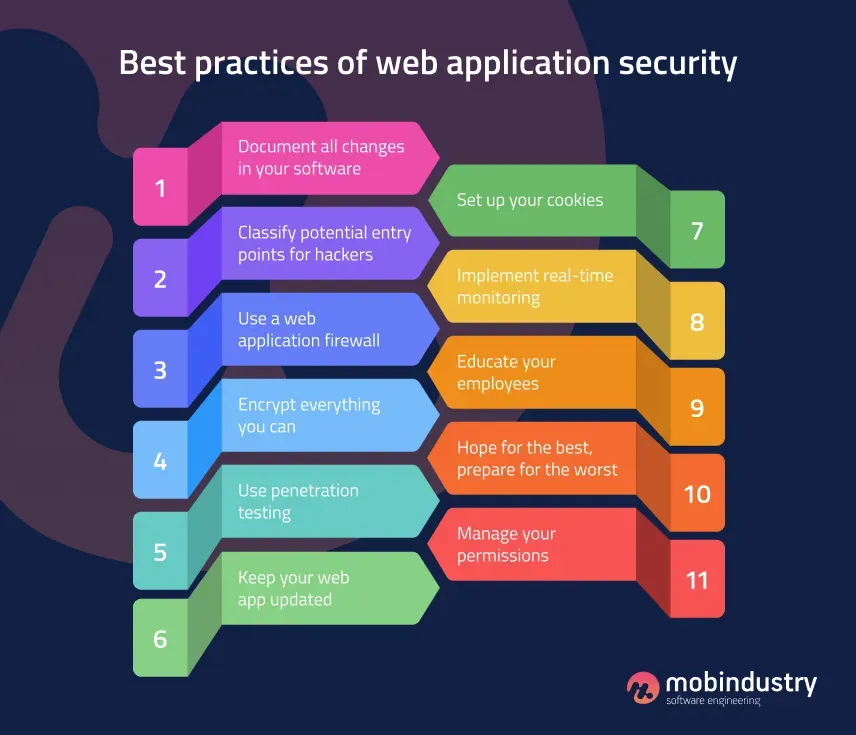
App Security Best Practices set the foundation for building safer software from the ground up in today's highly connected digital world, where user trust and regulatory compliance matter. As applications span mobile and web environments, teams must prioritize protecting user data, reducing attack surfaces, validating security controls, and delivering consistent security outcomes without sacrificing usability. A practical starting point is threat modeling, which rigorously helps map potential adversaries, data flows, touchpoints, and risk drivers that require robust protections before any code is written, reviewed, or deployed. Once threats are identified, apply data encryption to protect data at rest and in transit, and implement disciplined key management to minimize exposure, audit usage, and rotate credentials according to policy. By weaving these elements into design, development, and testing activities, organizations reduce risk and deliver resilient experiences that users can rely on across devices and ecosystems worldwide, while documenting outcomes for audits, governance, and compliance.
In other words, safeguarding software means a coordinated, multi-layered strategy that brings people, processes, and technology into harmony. This approach resembles a secure development lifecycle, where requirements, architecture, coding, testing, and deployment are guided by consistent security objectives. You will encounter terms like application protection, defense-in-depth, data protection controls, and robust identity and access management that help unify security thinking across mobile and web contexts. Framing security in this way supports risk-based decision making, clearer governance, and measurable improvements as teams iterate on safety throughout the product lifecycle.
1) App Security Best Practices: Building Secure Mobile and Web Apps from Day One
App Security Best Practices should guide every phase of software development, from initial design to production and maintenance. Embracing these practices helps ensure that mobile app security, data protection, and user trust are foundational rather than afterthought concerns. By starting with security in mind, teams can translate abstract protection goals into concrete design decisions that scale across platforms and teams.
A key starting point is threat modeling as a collaborative exercise. Cross-functional teams—product managers, developers, and security engineers—use frameworks like STRIDE or PASTA to map potential adversaries, data flows, and insecure touchpoints before writing code. This proactive approach illuminates where sensitive data resides, how it moves, and where defenses are strongest or weakest, forming the backbone of a robust secure architecture and supporting the broader mandate of App Security Best Practices across mobile and web environments.
With threat modeling in place, organizations can emphasize defense-in-depth, least privilege, and secure design choices that reduce risk from the outset. Integrating these considerations with ongoing security testing and secure coding practices creates a culture where protection is verifiable, auditable, and resilient to changing threat landscapes.
2) Practical Techniques for Implementing Security: Encryption, Secure Coding, and Ongoing Validation
Protecting data begins with robust data encryption and disciplined handling. Emphasize encryption at rest and in transit, deploy strong key management, and apply data minimization to reduce exposure. In practice, leverage TLS for network security and AES-256 or stronger for local storage, while ensuring keys are stored and rotated securely. Such measures are essential components of mobile app security and enterprise security for sensitive information.
Secure coding practices and dependency management go hand in hand with encryption to minimize the attack surface. Enforce rigorous input validation, parameterized queries, proper error handling, and least privilege across code paths. Regularly audit third-party libraries, update components to patched versions, and maintain a Software Bill of Materials (SBOM) to track risk. Secure coding practices, coupled with vigilant dependency management, strengthen the overall App Security Best Practices by reducing vulnerabilities arising from code and libraries.
Finally, integrate comprehensive security testing into the development lifecycle. Use static analysis (SAST) and dynamic analysis (DAST), automate vulnerability scanning and dependency checks, and conduct targeted security tests and penetration testing. For mobile apps, include checks for insecure data storage, reverse engineering risks, and tamper resistance, ensuring security testing validates protective controls across platforms and build pipelines.
Frequently Asked Questions
How do App Security Best Practices use threat modeling to improve mobile app security?
Threat modeling in the design phase maps data flows, identifies adversaries, and pinpoints where protections are strongest or weakest. Use structured methods such as STRIDE or PASTA and involve cross-functional teams to translate threats into concrete design decisions. This approach guides secure architecture, minimizes data exposure, enforces least privilege, and applies defense-in-depth, strengthening mobile app security across platforms.
What role do data encryption, secure coding practices, and security testing play in App Security Best Practices?
Data encryption is essential: protect data in transit with TLS and at rest with AES-256, use strong key management, and minimize stored data. Secure coding practices such as input validation, parameterized queries, proper error handling, and least privilege reduce vulnerabilities. Security testing—SAST, DAST, automated vulnerability scans, and targeted pen tests—validates controls throughout the SDLC. This combination applies across mobile app security and web apps, protecting data, reducing risk, and earning user trust.
| Area | Core Idea | Why It Matters | Practical Tip |
|---|---|---|---|
| Threat Modeling & Secure Architecture | Design-first approach; identify actors, data flows, and touchpoints; map threats to mitigations. | Sets a secure foundation and translates security objectives into concrete design decisions across platforms. | Involve product, development, and security teams; use STRIDE/PASTA; align mitigations with architecture choices. |
| Data Protection | Encrypt data at rest and in transit; minimize data collection and retention; manage keys securely. | Protects privacy, reduces attack surface, and aids regulatory compliance. | Use TLS and AES-256; rotate keys; enforce strict data handling and platform-specific storage protections. |
| Secure Coding & Dependency Management | Validate inputs, prevent injections, manage dependencies securely. | Reduces code and supply-chain risk; lowers likelihood of exploitable flaws. | Adopt parameterized queries, input sanitization, SBOM tracking; perform regular dependency audits. |
| Authentication, Authorization, & Session Management | Establish robust identity, access control, and session hygiene. | Prevents credential misuse and unauthorized access; supports a strong security posture. | Use OAuth 2.0/OIDC, MFA where feasible; short-lived tokens; ABAC/RBAC; secure cookies and token storage. |
| Security Testing & Validation | Integrate testing throughout the SDLC; identify vulnerabilities early. | Improves resilience and trust; reduces mean time to remediation. | Incorporate SAST/DAST, automated scans, code reviews, and targeted pen-testing. |
| Platform-Hardened Security (Mobile & Web) | Apply platform-specific protections; defend against device-level threats; reduce reverse engineering risk. | Ensures consistent security across environments and maintains a good user experience. | Protect device data, use secure storage/keystores, code obfuscation where appropriate; proper web protections. |
| Logging, Monitoring & Incident Response | Observability and prepared response for security events. | Enables rapid detection, containment, and learning from incidents; demonstrates accountability. | Centralize logs, monitor for anomalies, run incident response drills and post-incident reviews. |
| Privacy & Compliance Alignment | Maps security controls to privacy requirements and regulatory expectations. | Helps avoid fines and builds user trust by respecting data rights. | Coordinate with legal; perform DPIAs where needed; align with GDPR and regional laws. |
| Getting Started: Pragmatic Checklist | A practical starting point to implement App Security Best Practices. | Provides clear, measurable steps and roadmaps. | Threat modeling; encryption; secure coding; strong auth; CI/CD security; platform protections; monitoring; privacy alignment. |