
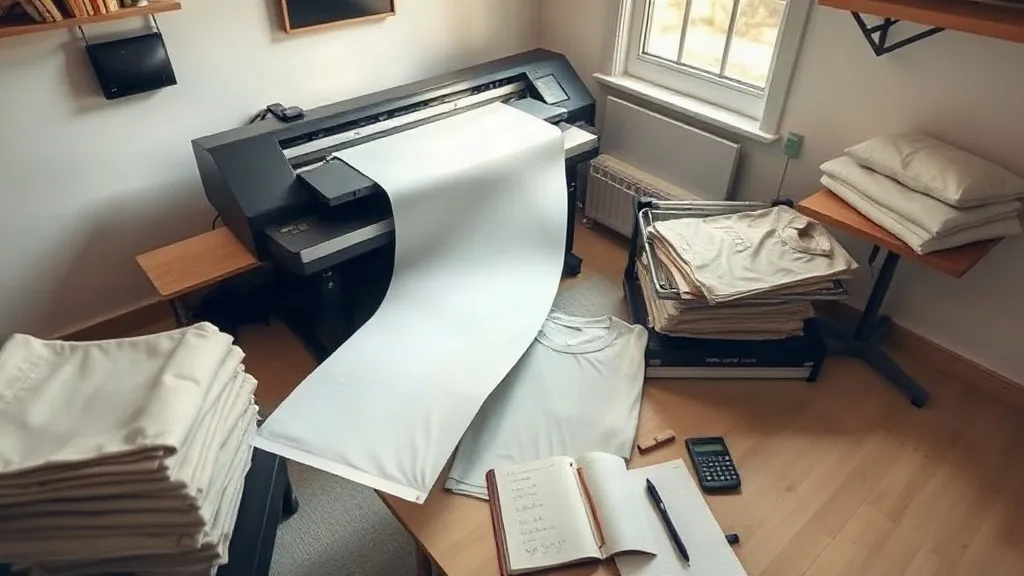
Ask ten small print shop owners how they price dtf transfers and you will likely get ten different answers, most of them delivered with a slight wince. Some charge by the sheet, some by the linear inch, some by the print itself, and a fair number simply match whatever the shop down the road is charging. That last approach is the one that quietly kills margins, because the shop down the road may be running a different film, a different powder, and a completely different cost structure. Pricing custom apparel work without knowing your true numbers is not a pricing strategy. It is a guess with a receipt attached.
This guide is not about which printer to buy or which film brand is best. It is about the part of the business most owners learn the hard way: the math behind a profitable job. If you already run a heat press and a cutter, you have most of what you need. What you may be missing is a clear picture of what each dtf sheet actually costs you once ink, powder, film, labor, and mistakes are all counted.
Start With the Real Cost of a Single Sheet
Most shop owners can tell you the price of a roll of film to the dollar. Far fewer can tell you what one finished, powder-shaken, cured sheet costs to produce. That gap is where profit leaks out. Building a proper cost per sheet means adding up five things, and none of them can be skipped.
The consumables you actually burn
Film, ink, and adhesive powder are the obvious three, but they are rarely consumed at the rate the spec sheet suggests. Ink coverage varies wildly between a bold block logo and a fine line illustration. Powder usage depends on how evenly you shake and how much you reclaim. A realistic starting point is to take your monthly consumables spend and divide it by the number of sheets you sold that month, then add a waste factor of roughly 8 to 12 percent for misprints, film jams, and test prints. That waste number is not pessimism. It is accounting.
Machine time and labor
Your printer, shaker, and press all consume electricity and, more importantly, your hours. If a gangsheet takes twenty minutes of active attention to build, print, powder, and cure, that time has a value. Many owners treat their own labor as free, which works fine until they try to hire someone and discover the job costs more than the revenue it generates. Assign an hourly rate to production time even if you are the only person in the shop. It keeps your pricing honest.
Press time per garment
Applying a transfer is not instant. A typical press cycle runs somewhere between 10 and 20 seconds depending on the film and fabric, plus loading, alignment, and peel time. On a large order of 200 shirts, those seconds turn into hours. If you quote a per-shirt application fee of one dollar and your press time is worth more than that, you are effectively paying customers for the privilege of working for them.
Build a Pricing Formula You Can Repeat
Once you know your cost per sheet and your application cost per garment, pricing becomes a repeatable formula instead of a negotiation with yourself. A simple and durable structure looks like this:
- Transfer cost: your true cost per sheet divided by the number of designs on it, plus a margin of at least 2.5 to 3 times.
- Application fee: press time plus handling, charged per garment, not absorbed into the transfer price.
- Setup or art fee: a flat charge for file preparation, especially for customers who send low-resolution images or need edits.
- Rush surcharge: a clear percentage for turnaround under 48 hours, stated up front rather than added in a sheepish follow-up email.
The margin multiplier matters more than the exact numbers. A 2.5x markup on transfers sounds generous until you subtract waste, failed prints, and the occasional remake you eat to keep a customer happy. Shops that run lean margins tend to discover this during their busiest month, when waste spikes and the profit disappears.
Why per-inch pricing often beats per-sheet
Charging by the linear inch of film used is a fairer model for both sides. A customer ordering a small left-chest logo should not pay the same as one ordering a full back print. Per-inch pricing also naturally discourages oversized designs that waste film and slow down the press. If you prefer per-sheet pricing for simplicity, at least tier it by size so small jobs are not subsidizing large ones.
The Costs Nobody Quotes Until They Hurt
Beyond consumables and labor, there are recurring costs that quietly eat into a shop's bottom line. Remakes top the list. A customer who receives a shirt with a crooked print or a cracked transfer will expect a replacement, and that replacement costs you film, ink, press time, and shipping. Building a small remake allowance into your pricing, even 3 to 5 percent, means the occasional failure is already paid for.
Storage and handling of blanks is another. Cotton blanks take up shelf space, attract moisture, and need to be counted. If you are holding inventory for a customer's order, that is a service with a cost. Some shops add a small handling fee for orders that require them to source and store blanks. Others build it into the garment price. Either works, as long as it is deliberate.
Equipment wear deserves a line too. Print heads clog, press pads flatten, and shaker motors eventually give out. Setting aside a small percentage of every job toward replacement keeps you from facing a sudden four-figure repair with no reserve. If you want a deeper look at how transfer quality affects your remake rate, the guide to dtf transfers covers the practical side of film and application choices.
Quoting Without Leaving Money on the Table
The quoting conversation is where most shops lose margin, not in production. A customer asks for a price on 50 shirts, the owner does quick mental math, rounds down to a friendly number, and sends it. That friendly number usually excludes setup, ignores rush timing, and assumes zero waste. A better habit is to build quotes from a template with every line item visible: transfer cost, application, setup, and any add-ons. Customers rarely object to a transparent breakdown. They object to surprise charges later.
It also helps to know your walk-away number. Every job has a price below which it is not worth the press time. Writing that number down, even roughly, gives you the confidence to decline work that would otherwise occupy a slot a profitable job could have used. Small shops that protect their calendar tend to survive longer than ones that chase every inquiry.
When to raise prices
If your consumable costs have risen and your prices have not moved in a year, you are already working for less. A modest annual review, communicated clearly and with notice, is far easier for customers to accept than a sudden jump after months of quiet losses. Most repeat clients understand that materials cost money. What they dislike is inconsistency, not adjustment.
Frequently Asked Questions
How much should I charge for a single DTF transfer?
There is no universal number, but a common range for a standard-sized design runs from roughly three to six dollars per transfer at retail, depending on size and complexity. Your own cost per sheet and waste rate should drive the figure, not what a competitor advertises. If your cost per transfer is above your selling price, no volume will fix the problem.
Should I include the application fee in the transfer price?
It is usually clearer to separate them. The transfer is a product; pressing it onto a garment is a service. Bundling hides the labor and makes it harder to quote accurately when a customer supplies their own blanks. A separate, stated application fee also protects you when a customer brings in garments that take longer to press.
How do I price a gangsheet for a customer who supplies their own artwork?
Charge for the sheet based on the space used, and add a file preparation fee if the artwork needs cleanup, color adjustment, or resizing. Customer-supplied files often look fine on screen and print poorly because of low resolution or missing bleed. A small art review fee covers the time you spend catching those problems before they become remakes.
What is a reasonable rush surcharge for DTF orders?
Many shops use 15 to 25 percent for turnaround under 48 hours and higher for same-day work. The exact figure depends on how much the job disrupts your normal production schedule. The important part is that the surcharge is published and applied consistently, so it reads as policy rather than a penalty invented on the spot.
Do smaller transfers really cost less to produce?
They consume less film and often less ink, but the fixed time costs of building a sheet, printing, powdering, and curing stay roughly the same. That is why per-inch pricing is fairer than a flat per-sheet rate: it reflects the material savings without pretending the labor disappears. A shop that charges the same for a pocket logo and a full back print is usually losing money on the small job and overcharging on the large one.